Growing up I spent a lot of time with my maternal Grandmother. Grandma Holbrook was born in 1912. She wasn't the cuddly kind of Grandma. She was tough as nails (literally, FYI), and came from an era where people had kids because they needed work done. She didn't really put me to work so much, however she was also disinclined to indulge any of my whining.
Grandma lived in a rural area where, in the past, her survival had depended upon her ability to maintain relationships with her "neighbors". In case you aren't familiar with country neighbors...the term really applies to almost anybody on your country block. And a country block might be three miles on a side. I recall that one time Grandma needed to make a delivery to Mrs. McManus down the road. Except that she really wasn't in the mood to chat for the hour and a half or so that she would need to invest if she arrived on Mrs. McManus's doorstep. So, she sent me to make the delivery on her behalf. I trudged a mile down the road with her package only to be regaled by Mrs. McManus about all manner of goodness knows what. I barely escaped her by dinner time, which may have been Grandmother's plan all along. She probably planned to kill two birds with one stone by making the delivery and keeping me occupied.
Grandma believed in running Errands. Whenever she said she needed to stop at a store, we all knew what she meant. This was going to be a full day of driving all over the better part of three counties. We would be packing sandwiches because there was a 0% chance that we would be home in time for lunch. In fact, there was a very good chance we'd be missing dinner too!
The trip would usually start with a logical premise: "I need to pick up some plants from Frank's Nursery". So, out the door we would head. A keen observer might wonder "Why do we need a bag full of sandwiches to go to one store?" But it would really be a waste to leave the house and drive all the way to Lansing for one store. So we would stop at several houses on the way to Frank's, vis'ting with people along the way. There would be at least two stops on the way to Frank's. And, you know, if you're in Lansing, you really need to stop at Horrock's. So, we'd stop there. Then we'd stop at half a dozen other businesses. Then we'd hopscotch back home, vis'ting with three or four people on the way back.
These trips used to leave Grandma exhausted for a day or two due to their length. But, as soon as she recovered, she would cook up some pretense for another trip and off we would go.
I never understood her obsession with "Vis'ting". At least, not until today. This morning I had the pleasure of visiting a friend from high school and her husband. We chatted for quite a while, exchanging stories and filling in the gaps left by the intervening years. Our kids played while we talked. When I left I reflected on how nice it was to catch up and make a connection with another person, in person.
Recent research indicates that people who maintain more connections with others live longer. Grandma lived longer than expected. She beat lymphoma into a ten year remission. She was hospitalized for nearly six months. Afterwards she had to walk with leg braces. On her way home from the hospital I am pretty sure she said something like "Do you mind if we stop at Frank's on the way home? As long as we're out this way, I need some vegetables from Horrock's. It's been a while since I checked in on Mrs. Johnson. You wouldn't mind one more stop, would you?"
As a kid I am sure I would have groaned "Here we go again!" After today, I might have said "That sounds like a good idea, Grandma. Do you s'pose she needs anything from 'Meijer's'?"
Friday, November 8, 2019


Saturday, November 2, 2019
Scary Aunt
Wow! If I believed in guilt, I'd feel terrible about how long it has been since I wrote a post.
Today I remembered something from my childhood. My Mom had a motor home. We made regular trips to Lake Michigan near Muskegon. My next oldest sibling was eleven years older than I am, so it's fair to assume that my Mom had her fill of kid crap before I came along. We used to take these Lake Michigan trips with my Aunt Judy. One of my Mom's favorite threats to enforce good behavior was "If you're naughty, you'll have to go sit with Aunt Judy!"
One day I crossed the line. I'm not sure where the line was, or what I did to cross it. But I did. So, I was sent to the front passenger seat of the motor (Aunt Judy was driving). I plopped down in the seat, with my most sullen face on. Furious that I had been banished. I should note that at this time, I really had not spoken much with Aunt Judy. When you're a kid, you don't pay much attention to adults.
So, there I was. Exiled to the front of the motor home. Terrified of what sort of awful thing my Aunt was going to do to me. She spoke first. "So, you must have gotten sent here because you were naughty?"
I stuck out my bottom lip and nodded.
"This must be pretty scary, huh?"
Again, I nodded.
"Tell me...which things have I done that were really scary?"
I thought on this for a while. Try as I might, I couldn't think of anything. In fact...I realized pretty quickly that my Aunt had been used as a threat because we were terrified of her, but she had really done very little to earn her reputation as a terrifying person. At least to us kids. My aunt and I chatted for the remaining two hours of the drive and it turned out that she wasn't always scary. I won't say "She wasn't scary" because she sometimes had a sharp tongue, but it turned out that she directed it at me (or any of us kids) very little.
As an adult I still question my opinions of people and whether they come from experience or reputation.
Today I remembered something from my childhood. My Mom had a motor home. We made regular trips to Lake Michigan near Muskegon. My next oldest sibling was eleven years older than I am, so it's fair to assume that my Mom had her fill of kid crap before I came along. We used to take these Lake Michigan trips with my Aunt Judy. One of my Mom's favorite threats to enforce good behavior was "If you're naughty, you'll have to go sit with Aunt Judy!"
One day I crossed the line. I'm not sure where the line was, or what I did to cross it. But I did. So, I was sent to the front passenger seat of the motor (Aunt Judy was driving). I plopped down in the seat, with my most sullen face on. Furious that I had been banished. I should note that at this time, I really had not spoken much with Aunt Judy. When you're a kid, you don't pay much attention to adults.
So, there I was. Exiled to the front of the motor home. Terrified of what sort of awful thing my Aunt was going to do to me. She spoke first. "So, you must have gotten sent here because you were naughty?"
I stuck out my bottom lip and nodded.
"This must be pretty scary, huh?"
Again, I nodded.
"Tell me...which things have I done that were really scary?"
I thought on this for a while. Try as I might, I couldn't think of anything. In fact...I realized pretty quickly that my Aunt had been used as a threat because we were terrified of her, but she had really done very little to earn her reputation as a terrifying person. At least to us kids. My aunt and I chatted for the remaining two hours of the drive and it turned out that she wasn't always scary. I won't say "She wasn't scary" because she sometimes had a sharp tongue, but it turned out that she directed it at me (or any of us kids) very little.
As an adult I still question my opinions of people and whether they come from experience or reputation.
Wednesday, February 21, 2018
How much difference does a camera sensor really make?
My wife and I have been married for 15 years this year, and we are hoping to take a special vacation together this summer to celebrate. Vacations mean pictures, and when I think about pictures and travel my rampant sense of optimization gets the better of me. I started wondering which camera(s) we should take. Do we take the Sony A7II which sports a full-frame sensor or do I take my Panasonic Lumix FZ-200. Gear for the A7II will be bulky and heavy, however the FZ-200 is entirely self-contained. Both cameras take outstanding photos in bright sunlight, and the lens on the FZ-200 reaches to a 600mm equivalent. The comparable A7II lens (not including body or adapter) is about the size of an old school Thermos and costs $900. That's more than the entire FZ-200 camera costs.
So, how much of a difference does sensor size make? The sensor in the A7II is 31 times as large as the sensor on the FZ-200, but has twice as many pixels. Each pixel, then is roughly 15 times as large as the same pixel on the FZ-200, which means 15 times as much light enters the camera for each pixel. Does that make any practical difference, though?
The image below was shot on both cameras, using in-camera Jpeg compression. They are both using 1/125 shutter speed, 1/3.5 aperture, and ISO 2500 light amplification. From a distance, both halves of the picture look similar. Once you zoom in, though, you can see how much noise the smaller sensor introduces into the photo. Download the full photo at this link.

Monday, September 4, 2017
Double Your Pleasure
While kayaking with a friend yesterday, he mentioned something that piqued my
interest. He essentially said that, in terms of dopamine levels, sex and
nicotine are on par…and that both pale in comparison to cocaine, which in term
can’t compare to methamphetamines.
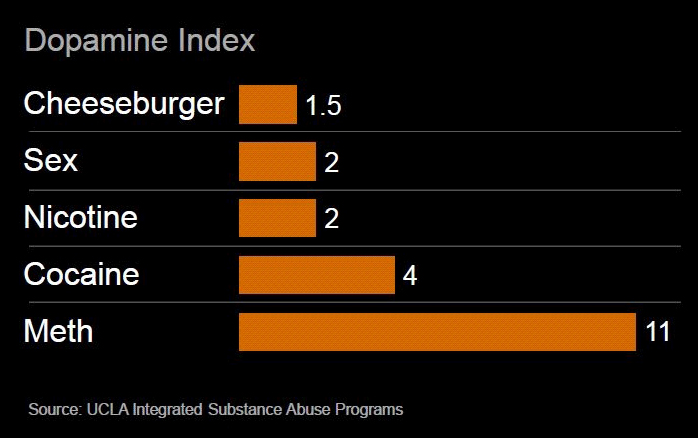
The image above is attributed to the UCLA Integrated Substance Abuse Programs, although I was unable to find the exact publication. I was however, able to find an excellent slideshow on PBS (narrated by Dr. Richard Rawson) which discusses the image above.
The baseline is 1. It’s interesting that the cheeseburger is halfway to sex and nicotine is on-par with sex. In the image above you can imagine that a methamphetamine user, whose baseline has been adjusted upwards from 1 to 11, probably doesn’t have good days unless they are using. On the other hand, if the most indulgent you get is an occasional cheeseburger…I’ll hazard a guess that you have a lot of good days, because your expectation for dopamine release is so much lower than even a nicotine user’s expectation.
It seems logical to me, then, that the key to living an extraordinarily happy life might be to limit your own exposure to things that spike dopamine levels. For example, if your typical meal consists of unadorned lettuce…an apple or an orange is perfectly heavenly in comparison. By indulging infrequently in activities which increase dopamine levels significantly, the increase from small pleasures should appear comparatively large.
The image above is attributed to the UCLA Integrated Substance Abuse Programs, although I was unable to find the exact publication. I was however, able to find an excellent slideshow on PBS (narrated by Dr. Richard Rawson) which discusses the image above.
The baseline is 1. It’s interesting that the cheeseburger is halfway to sex and nicotine is on-par with sex. In the image above you can imagine that a methamphetamine user, whose baseline has been adjusted upwards from 1 to 11, probably doesn’t have good days unless they are using. On the other hand, if the most indulgent you get is an occasional cheeseburger…I’ll hazard a guess that you have a lot of good days, because your expectation for dopamine release is so much lower than even a nicotine user’s expectation.
It seems logical to me, then, that the key to living an extraordinarily happy life might be to limit your own exposure to things that spike dopamine levels. For example, if your typical meal consists of unadorned lettuce…an apple or an orange is perfectly heavenly in comparison. By indulging infrequently in activities which increase dopamine levels significantly, the increase from small pleasures should appear comparatively large.
Monday, December 5, 2016
Being Purposeful
A coworker recently poked her head into my office and casually said "We've drafted an RFP for the new website, can I send it to you for review?"
Although I was pleased by the opportunity to opine, my eyebrows went up as I asked "How about if we get our teams together and make sure we all understand what we're looking for in a website, and then move on to the RFP?" We did, and it was a great conversation. Both the Marketing and Information Services teams had great ideas to add to the conversation, and I am sure that our website will be better for the discussion.
It seemed counterproductive to me that we would consider taking on any part of a project as big as redesigning our website without first understanding what we wanted to get out of the project. Yet...when I asked myself "What am I trying to get out of life?" I could not answer.
For someone as goal oriented as myself, this is a glaring omission. If my goal is to spend as much time with my daughter as possible, perhaps I should quit my job. If my goal is to maximize the amount of travel that Aimee and I do in retirement, perhaps we should downsize our house now rather than when we retire.
Of course there are many answers to this question for each of us. We probably want a mix of things out of life. If you were to write down some of the things you want out of life, how many of your actions today have moved you closer to those goals?
The answer for me today is "None." Tomorrow I will change that.
Although I was pleased by the opportunity to opine, my eyebrows went up as I asked "How about if we get our teams together and make sure we all understand what we're looking for in a website, and then move on to the RFP?" We did, and it was a great conversation. Both the Marketing and Information Services teams had great ideas to add to the conversation, and I am sure that our website will be better for the discussion.
It seemed counterproductive to me that we would consider taking on any part of a project as big as redesigning our website without first understanding what we wanted to get out of the project. Yet...when I asked myself "What am I trying to get out of life?" I could not answer.
For someone as goal oriented as myself, this is a glaring omission. If my goal is to spend as much time with my daughter as possible, perhaps I should quit my job. If my goal is to maximize the amount of travel that Aimee and I do in retirement, perhaps we should downsize our house now rather than when we retire.
Of course there are many answers to this question for each of us. We probably want a mix of things out of life. If you were to write down some of the things you want out of life, how many of your actions today have moved you closer to those goals?
The answer for me today is "None." Tomorrow I will change that.
Monday, August 8, 2016
A strange paradox
Imagine, for a moment, if you discovered that you were going to die in the next ten minutes. Most of us would hardly be at peace with such a prospect. In fact, we'd fight tooth and nail for another ten minutes.
So why is it that we spend so much time trying to escape from reality? We spend tremendous amounts of time using drugs to help us cope with reality, knowing full well that it's unhealthy and leads to terrible decision making. We spend days each year watching television, or even reading books. In fact there are very few things that we can't take to an unhealthy, obsessive level in our quest to avoid reality. In the end we'll regret most of it.
We will regret the extra hours we spent working, the times we went out drinking instead of exercising. In the end we will regret thinking less instead of more, and we will wish that we savored every experience...even the terrible ones. We'll wonder why we bought a new car instead of traveling to Ireland.
I don't know why we do this or what we should do instead. I don't know how to make myself savor each fleeting moment-including the ones I don't like. I'm curious, though...and that's a good start.
So why is it that we spend so much time trying to escape from reality? We spend tremendous amounts of time using drugs to help us cope with reality, knowing full well that it's unhealthy and leads to terrible decision making. We spend days each year watching television, or even reading books. In fact there are very few things that we can't take to an unhealthy, obsessive level in our quest to avoid reality. In the end we'll regret most of it.
We will regret the extra hours we spent working, the times we went out drinking instead of exercising. In the end we will regret thinking less instead of more, and we will wish that we savored every experience...even the terrible ones. We'll wonder why we bought a new car instead of traveling to Ireland.
I don't know why we do this or what we should do instead. I don't know how to make myself savor each fleeting moment-including the ones I don't like. I'm curious, though...and that's a good start.
Sunday, May 31, 2015
It's all about the goal
I had a race today, and I didn’t do very well. In fact, my race was doomed
before I started due to poor planning. It turns out, though, that it was a
powerful life lesson. Let’s start with the race itself...
It was cold when we started. About 45 degrees and raining. I signed up for the Olympic distance, which would mean spending about 2 1/2 hours in the rain.
The swim was actually pleasant; the water was substantially warmer than the air. The bike ride was more challenging. Several riders in front of me crashed painfully on a set of nearly invisible, unused railroad tracks. Rain coated my visor and made it tough to see. About 7 miles into the 26 mile course I splashed into a puddle that turned out to be a huge pothole. My water bottle ejected but I pressed on.
My ride suddenly got bumpier. Roads do that. Right? I looked down and noted that the pavement seemed pretty smooth. I pulled off to the side and saw that my rear tire was flat.
The flat wasn’t a problem; we keep spare parts on our bikes. The ten minute tire change was a problem though. I had gotten cold and the delay had destroyed my goal of finishing with an average bike speed of 20 MPH. I called it a day and headed in.
After some reflection, I realized that the day was a failure. Not from the tire, the pothole, or quitting early. Even before that. My two goals this race were to hang with some of my training partners, and the aforementioned 20+ speed. Both of those goals were intolerant of incidents such as a flat. A better approach would have been if I planned to set a personal record for an Olympic where I change a flat. Or, perhaps, a 20MPH bike leg omitting the mile where I changed the flat. In other words, in preparing for the race, it isn’t enough to put a flat kit on the bike. The flat kit needs to be partnered with a compelling, flat-tolerant goal in order to be truly useful.
This doesn’t just apply to cycling or racing. Having fault-tolerant, properly aligned goals is important in our business and personal lives too. How many businesses have we seen fail because they focus narrowly on profitability rather than their entire community? A small change in goal may have made all the difference for them.
It was cold when we started. About 45 degrees and raining. I signed up for the Olympic distance, which would mean spending about 2 1/2 hours in the rain.
The swim was actually pleasant; the water was substantially warmer than the air. The bike ride was more challenging. Several riders in front of me crashed painfully on a set of nearly invisible, unused railroad tracks. Rain coated my visor and made it tough to see. About 7 miles into the 26 mile course I splashed into a puddle that turned out to be a huge pothole. My water bottle ejected but I pressed on.
My ride suddenly got bumpier. Roads do that. Right? I looked down and noted that the pavement seemed pretty smooth. I pulled off to the side and saw that my rear tire was flat.
The flat wasn’t a problem; we keep spare parts on our bikes. The ten minute tire change was a problem though. I had gotten cold and the delay had destroyed my goal of finishing with an average bike speed of 20 MPH. I called it a day and headed in.
After some reflection, I realized that the day was a failure. Not from the tire, the pothole, or quitting early. Even before that. My two goals this race were to hang with some of my training partners, and the aforementioned 20+ speed. Both of those goals were intolerant of incidents such as a flat. A better approach would have been if I planned to set a personal record for an Olympic where I change a flat. Or, perhaps, a 20MPH bike leg omitting the mile where I changed the flat. In other words, in preparing for the race, it isn’t enough to put a flat kit on the bike. The flat kit needs to be partnered with a compelling, flat-tolerant goal in order to be truly useful.
This doesn’t just apply to cycling or racing. Having fault-tolerant, properly aligned goals is important in our business and personal lives too. How many businesses have we seen fail because they focus narrowly on profitability rather than their entire community? A small change in goal may have made all the difference for them.
Tuesday, May 5, 2015
Emotional Reasoning
As I drove home for lunch today, I remembered that I need to vote on Proposal 1. This immediately made me swear under my breath; then I had an “Aha!” moment.
Thursday, February 26, 2015
VO2 Max Testing
One of the big challenges faced by endurance athletes is estimating fueling requirements for long races. It's difficult to eat during intense exercise, and eating too much can have disastrous results. Eating too little will leave an athlete under-fueled during later portions of their race, which can lead to poor times or dropping out of the race. To help with this dilemma, endurance athletes train their bodies to consume fat more efficiently. The more fat we burn, the less carbohydrate we need to rely on. The problem, though, is that we need to gain a sense of how much fat we burn at various intensities in order to understand how we should fuel when we race. To answer this question, I turned to Spartan Performance for a VO2 max test.
Although finding the facility was a bit of a challenge, I need to note that Connie, Tyler, and Dr. Eisenmann were fantastic. Once I arrived for my appointment Tyler had me change (by the way, they have showers on-site). Next he took some baseline measurements for height and weight. After answering some questions they had me get on the bike where they fitted the heart rate monitor and head gear. The test works by measuring oxygen, carbon dioxide and the amount of exhaled air. A mouthpiece with a hose attached routes your breath through a machine. Although the setup can look a bit scary, it's pretty easy to get used to.
Testing
The test protocol was pretty straight-forward. We started with a couple minutes of warmup. The bike is set to require a specific amount of power no matter your cadence. My job was to try to keep my cadence above 60 as the power required to pedal increased. About every minute, Tyler increased the power by 30 watts. Both Tyler and Dr. Eisenmann yelled encouragement while I pedaled through higher resistance levels. Eventually, as Dr. Eisenmann says, the bike always wins. Indeed, it did. As so many other athletes before me, I claimed I could have gone longer.
Results
My VO2 max landed at about 54.5 ml/kg/min, but that wasn't what I was interested in. I wanted to know where to most efficiently produce power for distance racing. That number was more challenging. The low intensity numbers at the beginning of the test were clearly inflated, and the range available before we switch to 100% carbohydrate burning is surprisingly small. Dr. Eisenmann explained that nervousness at the beginning of the test can skew low-end results. Although he offered to re-schedule the test with an alternate protocol, I declined for now. I did get some ballpark numbers, which was my goal. They weren't good.
At a heart rate of 159, 63% of my calorie burn is already coming from carbohydrate. Based on a ventilatory threshold (which is different than, but often correlates with lactate threshold) of 188, a heart rate of 159 puts me smack in the middle of training zone 2. In the middle of zone 3, my carbohydrate to fat burn is about 80% to 20%. If I wanted to stay at a 50/50 fat to carbohydrate burn, I would need to stay right on the line between zone 1 and zone 2 and produce about 145 watts. This isn't very realistic for racing, even for a long race. Instead…I need to start training to eat better on the bike.
What's Next
I intend to do a running test in the near future, and I'll request the protocol that Dr. Eisenmann suggested for my next bike test. That protocol included 3 minute segments instead of 1 minute segments, and reduced load increases by about 15%. Although my results were a bit disappointing, they're informative. I'd much rather understand where I'm at now, than in the middle of a full distance triathlon when I run out of fuel. As the date for Louisville 2015 gets closer, I'll request another set of tests with the altered protocol. My VO2 max should have increased quite a bit by then, as well as ventilatory maximum. Both should indicate more efficient fat burning, and an improvement in VO2 max should indicate a successful training program.
I'd like to thank Tyler, Connie, and Dr. Eisenmann for their help, and I would recommend the same test to other distance athletes. $75 is a reasonable amount to pay for a much deeper understanding of your body. If you're interested in scheduling a test, you can find contact information at http://snapp.msu.edu/.
Sunday, November 16, 2014
Cardiac Drift
I've been re-reading Joe Friel's legendary triathlon training book The Triathlete's Training Bible in order to answer the question "What should the purpose of my workouts be?" While trying to answer that question, I happened across a section on determining race readiness. The protocol calls for doing an “aerobic threshold” workout for a given amount of time, depending on desired race distance and then looking for “decoupling”. For a half-iron race an athlete should be able to run for 90 minutes in low zone 2 without heart rate decoupling between the two halves of the run.
Decoupling refers to the phenomenon of heart rate tracking unpredictably with exertion. For example, it might seem reasonable that if you maintain your power level for a certain amount of time…your heart rate should also stay the same. In practice, as you fatigue, your heart rate will start to inch higher even if your pace remains exactly the same and the terrain is flat.
In order to test race readiness, then, you can keep your power output level and see if your heart rate stays even (See chapter four, table 4.6). I did exactly such a test this afternoon. In the interest of brevity, I only ran for 1.5 hours. First, I warmed up for a few minutes, then set my treadmill to a 10 minute pace and started my watch.
For 90 minutes, I ran the 10 minute pace. This put me squarely in zone 2 (average was 2.5). At this intensity I was burning a 50/50 blend of fat and carbohydrate (80% of HRmax roughly equals 65% of VO2max, which is about a 50/50 burn). Although my heart rate moved around a bit, the overall averages between the two halves of the workout were well within the 5% drift indicating poor event fitness. For the first half of the run, my average heart rate was 154.2 BPM. For the second half, it was 155.7 BPM, a difference of only 1.5 beats per minute.
Data: Cardiac drift test
Wednesday, October 22, 2014
In good time
I'm reading a book called Flow that discusses (amongst other things) the difference between pleasure and enjoyment.
Pleasure is pretty easy. It comes from watching TV, doing drugs, having sex, etc. The key is that pleasure does not necessarily require skill, and the pleasure will eventually wear off. The book describes enjoyment as similar to pleasure, except that it does not wear off. Enjoyment requires a challenge that can be surmounted, the skill (preferably well-developed) to conquer the challenge, and rules that describe how the challenge must be met, and how we know when we have emerged victorious.
Now, consider behavioral economics for a moment. In order for a behavior to exist, a reward must exist. For most of us, rewards need to be quickly associated with activities. If our actions are not rewarded in the timeframe we expect, there is a strong chance that we will discontinue the action (just ask Pavlov!).
Recently I've found myself questioning the timeframe that I use for myself, and I've found that it might be a bit short for the job that I'm in. My timeframe is generally weeks and months. The other people on my team generally think in days or weeks. Other members of the executive team might tend towards thinking in terms of several months (IE quarters). In order to make the best long term decisions, and undertake the activities that best support our long term goals, I need to get out of the habit of being quickly rewarded for the activities I undertake. Enjoyment might easily take months or years.
Pleasure is pretty easy. It comes from watching TV, doing drugs, having sex, etc. The key is that pleasure does not necessarily require skill, and the pleasure will eventually wear off. The book describes enjoyment as similar to pleasure, except that it does not wear off. Enjoyment requires a challenge that can be surmounted, the skill (preferably well-developed) to conquer the challenge, and rules that describe how the challenge must be met, and how we know when we have emerged victorious.
Now, consider behavioral economics for a moment. In order for a behavior to exist, a reward must exist. For most of us, rewards need to be quickly associated with activities. If our actions are not rewarded in the timeframe we expect, there is a strong chance that we will discontinue the action (just ask Pavlov!).
Recently I've found myself questioning the timeframe that I use for myself, and I've found that it might be a bit short for the job that I'm in. My timeframe is generally weeks and months. The other people on my team generally think in days or weeks. Other members of the executive team might tend towards thinking in terms of several months (IE quarters). In order to make the best long term decisions, and undertake the activities that best support our long term goals, I need to get out of the habit of being quickly rewarded for the activities I undertake. Enjoyment might easily take months or years.
Sunday, October 19, 2014
Overwhelming Force
For as long as I can remember, I've had the same approach to playing games. In middle school I played competitive chess (poorly). As a young adult I spent countless hours playing video games, using much the same overall approach that I used with chess. As an older athlete, I find myself using the same approach to my racing as well.
The general strategy is simple: amass resources, wait out the opponent, and then bring overwhelming force to bear on any weakness that appears. As a kid, my endgame was terrible. If I got that far, my preferred strategy had already failed and I was likely to lose. As an adult racer, I find that I always have enough gas in the tank for one final all-out sprint. This means that I've under-applied myself to the entire race up to that point.
While this strategy works for relatively simple situations, it does not work for complex situations. Complex situations require surgical precision and the ability to address multiple fronts simultaneously. Any multi-dimensional problem creates multiple fronts that dilute the overwhelming force strategy. Additionally, an opponent that employs the same approach can cause the loss of most of both of our resources, then win with only a modicum of finesse.
Finesse is the key, as it augments strength and applies it most judiciously. As I consider my personal development goals over the next year, moving beyond the use of brute force will be at the top of my list.
The general strategy is simple: amass resources, wait out the opponent, and then bring overwhelming force to bear on any weakness that appears. As a kid, my endgame was terrible. If I got that far, my preferred strategy had already failed and I was likely to lose. As an adult racer, I find that I always have enough gas in the tank for one final all-out sprint. This means that I've under-applied myself to the entire race up to that point.
While this strategy works for relatively simple situations, it does not work for complex situations. Complex situations require surgical precision and the ability to address multiple fronts simultaneously. Any multi-dimensional problem creates multiple fronts that dilute the overwhelming force strategy. Additionally, an opponent that employs the same approach can cause the loss of most of both of our resources, then win with only a modicum of finesse.
Finesse is the key, as it augments strength and applies it most judiciously. As I consider my personal development goals over the next year, moving beyond the use of brute force will be at the top of my list.
Saturday, October 11, 2014
Book Review: Racing Weight

Shortly after the opening, the author of Racing Weight begins backpedaling on the the term "racing weight" and replaces it with "optimal body composition". Obviously these two terms have radically different connotations, however only one of them is likely to garner reads for a book.
Optimal body composition, Mr. Fitzgerald asserts, comes about as an adaptation to training in almost any sport. This is somewhat at odds with my own perception on the topic. I had assumed (probably incorrectly) that athletes focused on body composition for their sport; not that training for a sport caused a particular body composition. If you take a moment to consider athletes from a range of sports, you'll begin to notice that elite athletes in a particular sport do indeed share certain composition characteristics. For example, elite triathletes are also accomplished marathoners...but their body composition is much more muscular than their running-focused counterparts. The reason is that for 2/3 of a triathlon, weight has little bearing on performance, but muscle mass is very important. For running, weight trumps upper body musculature as a runner must "press" their own body weight with each stride.
So how does an athlete achieve optimal body composition? The author suggests a six step approach: Improve diet quality, manage appetite, balancing energy sources, self-monitoring, timing nutrients properly, and training in a way which is conducive to optimal body composition.
Diet quality is the most difficult step for most of us, although it need not be. Several years ago I was trying to put on muscle weight when I observed that it is challenging to gain weight while eating a very healthy diet. Body builders frequently lament "feeling bloated" for this reason. A healthy diet is high in fiber and low in caloric density; overeating on a healthy diet is a really uncomfortable endeavor.
In order to provide guidelines for healthy eating, the author devised a scoring system that encourages healthy eating. The system considers only food quality and serving size, rather than calories. For those of us who gravitate towards rich foods, simply asking ourselves where our next handful of peanut butter M&Ms will land in the scoring system may guide us away from poor eating decisions.
Overall the book is well-written, well-cited, and easy to digest. The food quality scoring system is a bit cumbersome, but not terribly more difficult than counting calories. Whether the advice in the book really works remains to be seen, however I intend to put it to the test. Right after I finish this bowl of ice cream.
Location:W Chippewa Trl,Shelby,United States
Monday, October 21, 2013
Jonesin'
Now that we are in the off-season for triathlon, I've started obsessing about what the next on-season should look like. Inevitably, I start to think about efficiency and problems like overheating while racing. This invariably brings me around to a sad truth: my body fat level is too high. Excess body fat means that you're wearing a snuggy while racing. A 10-15 lb snuggy. Made out of space-age materials that make you really, really warm.
So, bright idea time! I want to trim up my carbohydrates just a wee bit so that when I race, I'll carry less weight and hopefully run a bit cooler too.
There's only one, tiny problem. I love the fix I get from ultra-processed carbohydrates. The more synthetic, the better. Sure, they're hell on your body, but they taste so darned good!
After having a pretty good day watching my dietary intake of calories and macro-nutrients, I got the jones this evening. Having sworn off (ran out of) carbohydrate-laden beer, I couldn't stop thinking about the bread I baked last weekend. Once I'd mentally given in to the idea of eating the bread, I mentally upped the ante and decided to go for the gold: melt-in-your-mouth super-ultra-mega-refined fried goodness Bugles. I try to stay away from them because after the first one, there is a good chance I'll wake up naked in a ditch in a couple of days.
My mouth started watering before I even had the bag open. I felt like a salivating dog in a lab experiment. I dumped a generous helping onto a plate.
Afterwards, as I sat thoughtfully munching on almonds and beef jerky, I wondered where my clothes went before I fell asleep in the ditch. I also realized that it is going to be a really tough off-season if I don't find a way to tame my cravings. Or at least indulge without suffering hypothermia.
So, bright idea time! I want to trim up my carbohydrates just a wee bit so that when I race, I'll carry less weight and hopefully run a bit cooler too.
There's only one, tiny problem. I love the fix I get from ultra-processed carbohydrates. The more synthetic, the better. Sure, they're hell on your body, but they taste so darned good!
After having a pretty good day watching my dietary intake of calories and macro-nutrients, I got the jones this evening. Having sworn off (ran out of) carbohydrate-laden beer, I couldn't stop thinking about the bread I baked last weekend. Once I'd mentally given in to the idea of eating the bread, I mentally upped the ante and decided to go for the gold: melt-in-your-mouth super-ultra-mega-refined fried goodness Bugles. I try to stay away from them because after the first one, there is a good chance I'll wake up naked in a ditch in a couple of days.
My mouth started watering before I even had the bag open. I felt like a salivating dog in a lab experiment. I dumped a generous helping onto a plate.
Afterwards, as I sat thoughtfully munching on almonds and beef jerky, I wondered where my clothes went before I fell asleep in the ditch. I also realized that it is going to be a really tough off-season if I don't find a way to tame my cravings. Or at least indulge without suffering hypothermia.
Wednesday, June 5, 2013
Race with me!
Imagine if you got into your car and drove 55MPH for an hour and 17 minutes (1:17) without stopping. After 77 minutes you stop your car and decide to leave your car where it is an make your way back home by swimming, biking, and running. That’s a half ironman distance race. The race is a 1.2 mile swim, a 56 mile bike ride, and a 13.1 mile run
Friday, May 3, 2013
The Long Run is not for sprinters

As I started getting close to running a half marathon, my knees hurt and my calves were constantly in excruciating pain. I started reflecting and realized that I had developed bad habits that would hamper my distance running efforts. In a short run, you can get away with sloppy form. In a long run, your muscles will eventually become exhausted. At this point you are very likely to develop an injury.
One of the things I realized I was doing is swaying side to side and bouncing up and down. This was tiring my muscles faster because it took more work, and it was putting a lot of lateral stress on my knees. So, I started looking ahead to a stationary object in front of me. If I could keep that object from bouncing around, I knew that I was directing more of my effort into moving me forward.
At work, I’ve been exhausted lately. I have found it challenging to do the right things quickly enough. It is high time that I look ahead, find a landmark, and do my best to keep it in the center of my field of vision. I’ve moved away from the sprinter’s race, and it’s time that I start using techniques that lead to success in the Long Run.
Thursday, May 2, 2013
The Litter Box Miscalculation


Litter training Abby has worked out really, really well. Of course, it was logical to litter train Sue when we got him. So that’s what did! When he was little, we taught him to go potty on command and then we transitioned him to the litter box. When we started leaving him in a large pen in the garage, we got him a large litter box since he had gotten so big. Everything generally seemed to work out ok.
We may have miscalculated something just a wee bit. To Sue, any litter box is a litter box. If you really have to pee, the litter box can save you. This works great when it’s the huge litter box out in the garage. The other night we heard the telltale sound of running water. Gushing, really. So we raced into the laundry room and found Sue making a valiant attempt to use the litter box, but failing miserably all over the floor.
Next time maybe we’ll reconsider the whole litter training thing when the dog is going to develop a gallon sized bladder.
Wednesday, March 20, 2013
Indomitable
Something yesterday reminded me of one of the greatest football players ever. What I remembered is his resilience. Even if you aren’t a football fan, I think you’ll find the following inspirational.
“Genetically, he seemed to be just like a rubber ball,” said Larry Ely, a linebacker. “When he got tackled, four . . . five . . . six people would have his legs, his neck, his arms, and he’d bounce back like a rubber ball to the huddle. How in the world did his ligaments and muscles take the pounding and bounce right back? You looked at him and wondered how any human being could be blessed with such a body.”
It wasn’t just genetics, he was sending a message. Walter Payton didn’t want to give anyone the satisfaction of having “gotten” to him. In an interview he once described taking a punishing hit. No matter how badly it hurt, he made a point not of just getting up, but of springing up. He wanted to make it clear that he could take whatever his opponents could dish out, and then some. He was indomitable by choice, regardless of circumstance.
Walter’s tips on making it for the long haul apply to us almost as certainly as they applied to him: http://www.youtube.com/watch?feature=player_detailpage&v=Oq86kzcJTqY#t=211s
Saturday, January 12, 2013
Dedication
I've done a terrible job adhering to my fitness goals over the last couple of weeks. In reflecting upon this, although I'm disappointed with myself, the primary goal is to get back on track. First, a quick recap of where I fell off the wagon.
Over the holidays I did two things that brought back an old, familiar friend-injury. First, the weather forced me to run on a treadmill. Instead of reading up on treadmill running first, I hopped on and assumed that it would be just like running outdoors. It turns out that it isn't quite. It is a lot more repetitive, which leads to repetitive strain injuries. Also, the treadmill that I used was a bit on the small side-which caused me to alter my stride. Between the two I started to experience some mild knee soreness. This would have been acceptable if I hadn't compounded the issue by swimming too much.
After swimming 73 laps over the holiday break, my knee soreness became knee pain. It felt like hyperextension. At first, I thought that it was strictly a result of the treadmill. Only after cutting a later swim short did I realize that I've done even less swimming over the last several years (um, about 25 years) than I have running.
Dedication, it appears, it about exercising exactly the right amount. I've been overdoing it again. I'll slow it down. After some reading and working with a heart rate monitor I've decided to alter my approach to training a bit. I'm going to broaden my cross-training, and cut back on my swimming distance for now. I'll also do only one long run per week, with two 45 minute runs during the week to run high intensity intervals. My aim is to reduce the risk of a repetitive strain injury while building up the muscles that I need in order to complete long endurance races. In short, I'll do less at a much higher intensity. I am also going to beef up my weight lifting and running specific exercises (clam shells and side lifts mostly).
Getting back on the fitness wagon should be relatively straightforward. I just have to convince myself that less is more when it comes to working out. The other problem, though, is that it will burn fewer calories. Watching my diet closely enough will be the next hurdle.
Over the holidays I did two things that brought back an old, familiar friend-injury. First, the weather forced me to run on a treadmill. Instead of reading up on treadmill running first, I hopped on and assumed that it would be just like running outdoors. It turns out that it isn't quite. It is a lot more repetitive, which leads to repetitive strain injuries. Also, the treadmill that I used was a bit on the small side-which caused me to alter my stride. Between the two I started to experience some mild knee soreness. This would have been acceptable if I hadn't compounded the issue by swimming too much.
After swimming 73 laps over the holiday break, my knee soreness became knee pain. It felt like hyperextension. At first, I thought that it was strictly a result of the treadmill. Only after cutting a later swim short did I realize that I've done even less swimming over the last several years (um, about 25 years) than I have running.
Dedication, it appears, it about exercising exactly the right amount. I've been overdoing it again. I'll slow it down. After some reading and working with a heart rate monitor I've decided to alter my approach to training a bit. I'm going to broaden my cross-training, and cut back on my swimming distance for now. I'll also do only one long run per week, with two 45 minute runs during the week to run high intensity intervals. My aim is to reduce the risk of a repetitive strain injury while building up the muscles that I need in order to complete long endurance races. In short, I'll do less at a much higher intensity. I am also going to beef up my weight lifting and running specific exercises (clam shells and side lifts mostly).
Getting back on the fitness wagon should be relatively straightforward. I just have to convince myself that less is more when it comes to working out. The other problem, though, is that it will burn fewer calories. Watching my diet closely enough will be the next hurdle.
Monday, November 26, 2012
Training Curve
Apparently, it actually takes muscles to run! My complete lack thereof appears to have finally caught up to me.
Subscribe to:
Posts (Atom)
